Mariborsko Pohorje 1042m

February 20th, 2010

This year’s skiing destination was chosen to be in Slovenia, in the vicinity of Maribor: the 2nd largest city in Slovenia. The city is situated on the Drava river at the bottom of the mountain Pohorje.

Unfortunately I did not have much time to explore Maribor itself, but the hotel itself (Hotel Orel), where we stayed, was right in the heart of the city. The small part I’ve seen gave the impression of a quite nice and clean city. It is important to note, that Maribor is planned to be the European Capital of Culture in 2012.
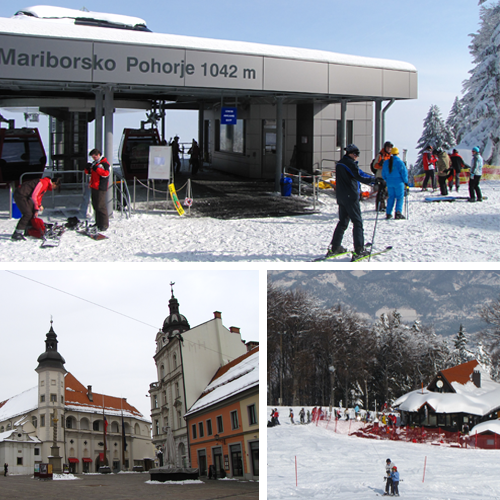
Maribor Pohorje
So, the slopes. The slopes on Pohorje are OK. The only bad thing is the fact that last year I’ve been to one of the biggest resorts in Europe (Les 2 Alpes, France) so the point of reference was quite high. Of course it is by far not as big as last year’s complex on the very top of the Alps, but I think it is a quite neat place.

The difficulty of the slopes varies from easy blue trails to steep black ones. Personally I enjoyed the winding blue slopes mixed with a few wide, red shortcuts. Although it was the middle of the week the slopes were quite crowded, with children learning to ski, but also with pro-skiers thundering down with high speed.
There is a quite modern system of cable-cars and open-chairs which one can use to go back up the top after a fun-ride down. I have no idea about the prices, because for us it was included in the holiday-package we just asked for it at the ticket-shop, presenting the papers they gave us at the hotel.

The entire atmosphere reminded me very much of Austrian/German atmospheres: beer, huge quantities of food and the music. The music was the exact sound as the German counterparts, just that they were all in Slovenian. I guess neighboring countries borrow a lot from each-other. And speaking of neighboring countries: Slovenia is also neighbor with Italy. Italy is famous for their pizzas. That was borrowed also: I do not know if it was the fact that I was hungry or not, but the pizza I ate in a restaurant at the bottom of the slopes was really-really good.

The Pohorje slopes also allow evening-skiing. The front part of the slope-system can be entirely lit in the evening. So after the break between (4PM to 6PM), when the slopes were closed, the second part of the skiing-day started and the slopes were lit to allow skiing in the evening. I did not try it because I was always too tired of the morning rides, but it was quite an interesting sight from the city to see the slopes lit on the neighboring mountain.

Because I am a fairly newbie skier, this year I have only bought ski-boots, because I was told they were more important that the skis themselves. The skis: I have rented them at the bottom of the slopes. They charged me €61.2 for a pair of skis and poles for 4 days. The good thing about renting was that I could leave the equipment at the renting office every day, so I did not have to drag them with me every day.
Which is a good thing, because we were four and I could only fit 3 pairs of skis+poles in my car (although I have a quite neat inner ski carrying system in the car, about which I could tell entire stories, but this is not the time).

The holiday package also included free pass into the local wellness center: a good place to relax after a day of skiing. We used it every day. They have a lot of things from different types of jacuzzi, to sauna. They also had an outside swimming pool with hot water in it. It was interesting to swim in hot water while it was snowing 🙂 .

I must also not forget the community which invited me to this great holiday: the Élő Erdély Egyesület (“Living Transylvania Association”). I am not a member, but I know some people from it, so they were kind enough to invite me also, so I think I have to say: Many Thanks 🙂 , I enjoyed the holiday.

I almost forgot: here’s a link to my Picasa gallery about the holiday. Enjoy 🙂 .

—==[#8]==—
802 km… and back

February 18th, 2010

First I have to say I am sorry for the long time span during which my blog has been in the same state. Think this is what happens when someone goes on vacation for a week before another busy week at work.

So… where was I? Well, I went skiing. And this post is going to tell the first part of my experiences (Yuppieeee, back to posts about traveling 🙂 ). In this post I would like to talk about the road to our destination: Maribor, Slovenia. About Maribor and the ski-slopes I will tell in the next part of this double article. That story requires a bit more writing and my fingers right now are not suitable for that great task… In this article I am going to talk about something much more important than the skiing itself: how to get there? (After all, there is no skiing if you can’t get to the slopes).

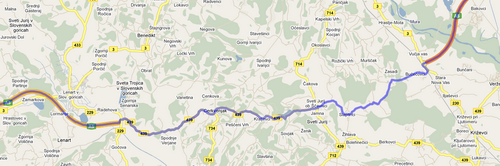
Since I decided to go by car, I had planned a simple route using Google maps. This is what the plan looked like:

This meant a simple drive from our sluggish roads until I got to the Hungarian highways. From there on it was a piece of cake. I must say the Hungarian highway system is quite good (so far I have tried driving on M1, M3, M35, M7 and M70). The roads are new, consequently still good and the traffic was always acceptable. What I didn’t like was the fact that Budapest’s highway-ring was… well, practically unusable: M0 has such a big radius, that it is better to use one of the inner circles and drive through the city. I also noticed the annoying fact, that after entering from Slovenia (M70->M7) if you do not buy a vignette in Slovenia, you have to drive for a couple of kilometers until you find a place to buy a vignette (basically driving illegally in that period).

After Hungary, the portion which worried me a bit was the supposed break of the Slovenian highway (A5). On Google maps it looked like this (I made a snapshot because this might change soon):
Slovenia A5
I have actually printed the map in high detail in case I got lost on the side-roads which connect the two loose ends of the highway. When I got there, surprise-surprise: the A5 was ready entirely and I just had to follow it until Maribor (shame on you Google 😛 )

A few more things about prices:
Hungary: Vignette for 4 days: is 1170HUF (€4.5 or 18RON). Despite this fact, I have payed cash at the entry in Hungary from Romania and they told me I can use RON, too. I was not paying attention to the conversion and they charged me 30RON for the vignette (nice busyness…). A small fine (like forgetting to turn the lamps on, after re-fueling and driving like that for a few kilometers): 10000HUF (~€35 – if you can explain yourself to the policeman). The gas price was around €1.14 (at a Shell pump).

In Slovenia I payed for the Vignette for 7 days €15. I did not have to re-fuel so I have no idea on fuel prices, but I am guessing a little over the Hungarian prices.

—==[#7]==—

Uplifting Trance #2

February 4th, 2010

In my last post I have presented a track which was voted #1 in the radio show A State of Trance. There was however another track in the Top 20, which made it only to position #8, although even Armin Van Buuren admitted that he thought it would get higher in the list. In my opinion it shouldn’t have been higher, it should have been on the very top of the list.

It is another example of a great uplifting trance with a superb build-up sequence and a very moving sound. It has to be noted that this track is not an entirely original piece. It is actually a remix done by Jorn Van Deynhoven to the original work of RAM: RAMsterdam. Compared to the original however, I think the changes have transformed the entire tune into a different, much better one.

—==[#6]==—

Gaia – Tuvan

February 2nd, 2010

Gaia, or on it’s more known name, Armin Van Buuren, has released a track last year which was voted the best hit of 2009 on the show hosted by Armin Van Buuren himself: A State of Trance.

The name Gaia as a cover name was chosen for a simple reason:
“I know if I’d released it as Armin Van Buuren it would have sold better but I wanted to show that trance mattered and that I’m very much about instrumental electronic music,” he says. (DJ Mag).

Judging by the sound, I’d say the title “Tuvan” refers to the Tuvan Language. The main melody of the track does have some oriental/mongolic sound, so I’d say it has something to do with that, although I could not find any official statement about this.

—==[#5]==—

The First House

January 31st, 2010

That is the translation of the current crediting program financed by our government and executed by a few selected banks in our country. Since I got fired up by the offer I saw (see previous post), I did a research on the offers the banks had. The offers have some difference, so I did a preliminary research on them using only data published on their websites. I have selected three banks:

I took as target credit the value of the flat I liked (without the garage): €42.000, and a crediting period of 240 months (20 years).
Banner BT
The first bank I examined, was BT, the preferred bank, because it is the regions bank and because I like them in general 🙂 . They offer only one, basic crediting mechanism, with a flat paying rate of €257.91/month. This value is however composed of the credit+interest which varies along the 240 months:

Month # Rate Interest Fees Total
Month 001 €99.87 €158.04 0 €257.91
Month 240 €256.89 €1.02 0 €257.91

Although I have written 0 to the Charges section, there are occasional charges to be payed at certain periods. These are handling fees by the bank, which occur only occasionally.

There are also initial payments that have to be done when applying for the credit. According to the bank’s website, these are the numbers:

Advance €2100 5% of the credit
Credit fee 0 it says “gratuit”
Guarantee €472.92 3 rates of the interest
Evaluation 0 Done by BT evaluator
Total €2572.92 – estimation

Banner BRD
Next I examined BRD. This bank seems to offer two methods of paying the rates: it offers an almost flat payment rate with the following characteristics:

Month # Rate Interest Fees Total
Month 001 €119.36 €105.24 €39.9 €262.49
Month 240 €224 €0.59 €0.22 €224.82

and another type, the decreasing payment rate, with the following characteristics:

Month # Rate Interest Fees Total
Month 001 €166.25 €158.04 €39.9 €311.39
Month 240 €166.25 €0.44 €0.17 €166.85

The advantage of this second type of payment rate is of course the fact, that the rates are actually being payed at the flat rate… in other words this is the actual flat rate payment. It could represent a huge advantage when trying to pay the rest of the credit instantly in the future.

Here is the list of down-payments that have to be done when applying for the credit:

Advance €2100 5% of the credit
Credit fee 0 it says “gratuit”
Guarantee €314.77 3 rates of the interest
Evaluation €100 Approximation. By preferred evaluator.
Total €2514.77 – estimation

Banner BCR
Unfortunately BCR does not offer any calculator to calculate the rates for this type of credit. For this reason I do not know what the rates are. I was able to gather some information about the down-payments:

Advance €2100 5% of the credit
Credit fee €79.8 0.2%
Guarantee €400 Approximation. 3 rates.
Evaluation €83 300RON + Taxes
Total €2661 – very rough estimation

The research shows, that in order to have this type of credit the down-payment is really low. However it must be taken into consideration, that additional charges may be asked by the real-estate agency (see my previous post) and take into account that you might need some money for furniture also. The rates themselves are OK, but can be changed and I think they will be changed during the crediting period. For this reason I like the 2nd offer of BRD, where you actually pay linearly the credit, so after 10 years, there will be actually 50% payed of the credit and the rest is easier to be payed…

—==[#4]==—


