What’s that on the Hill?

June 17th, 2011

Apart from the obvious sign telling the visitor the name of the location, an old fortress is looking over the city of Deva from the top of the hill. The big grey building is actually the Fortress of Deva and has been an important position in the history of not only Transylvania but also of Medieval Hungary. Unfortunately since then the fortress (or sometimes even castle, depending on the time period) got greatly deteriorated and so not much is really visible of it.
Deva
In the last years, however, some important development has commenced on the fortress and the local authorities started an ample renovation program to restore the fortress to a more “visitable” state. For this reason, we gave a shot to go and visit the old ruin.

Actually getting to the hilltop to the castle is not easy-peasy (or at least we thought so). First of all, when entering the city from the direction of Hunedoara, it is not marked anywhere where to start the ascent from. If you ask the local people, first they will tell you to go round on the path to get to the top: that route however is not for everyone. Instead there is a nice new “vehicle” that can get you on top, you just have to know where it’s base-point is. The local’s told us, that if we go to the stadium, we can get up using a funicular… Wow, that is cool: but where’s the stadium? Well, look for a football-field (for the mentally challenged: soccer-field) and do not, by any means, look for a stadium. Then, maybe, you’ll get to the base point 🙂 . Getting up is actually quite fun: the funicular is modern and new (a bit shaky at some key-points), a two-way trip costs 10 RON (€2.40) (half price for students) and it gets you up to the top in a few seconds. Actually it seems to be quite unique, I have never seen such a funicular: it is kind-of a mix between a funicular and a cable-car…

Once up on the top, do not, by any chance, try the heroic approach, to first go around the fortress: the road towards the right leading a “just a bit” downwards will actually lead down to the bottom of the hill, so unless you are curious of the old gatehouses (which are in a really bad shape), that direction can be skipped. Instead follow the stairs into the heart of the fortress to get a glimpse of the interior. Although it is limited since construction has begun, much of the interior court is visible and if you have a good zoom on the camera, some details can also be admired. Hopefully when renovation works will finish, a better access will be allowed for tourists, to actually admire the cells and maybe even some of the intact rooms (sort of) of the fortress.

Apart from the actual fortress, a magnificent view opens up from the hilltop not only towards the city center but also towards the surrounding areas of the city of Deva. Now for this, the great zoom of the camera is really useful 😉 .

“All in all” it was a great half an hour visit and hopefully it will get better after renovations finish. Oh…. one more thing: there is a very important sign on the walls of the fortress: “Be careful Vipers”. They mean it: the hilltop is also a natural reserve for the horned viper. We did not encounter any, but I’m guessing they did not put up the sign just to scare off tourists…

Photos here

[16]

A Medieval Touch

June 15th, 2011

There are a lot of castles in Romania. The sad part is, that most of them are in ruins and there is not much to see really on them. I have, however, been planning a visit to one castle in the country which is not in ruins… in fact it is in a quite good shape: the Corvinus Castle in Hunedoara. The castle belonged to the Corvinus family, which is very important in the history of both Romanian/Hungarian (Hunyadi János) and especially in Hungarian history (King Mátyás I). Apart from this great heritage the castle itself has a very imposing structure with excellent medieval aspect still admirable today.
Corvinus Castle
The really big challenge of the whole trip was getting there: although 190kms should not be a problem by car nowadays (from Cluj to Hunedoara), here in our beloved country it can be a challenge. I was really thinking about organizing maybe a two day trip and sleep somewhere in the area for the night and maybe add another POI in the region to make the trip worthwhile. In the end I went for the single day trip and also added another POI (which I will describe in a separate post). I calculated 3 hours for the road (one way), but it is actually easily doable in about 2:45 hours following the E81 then E68 roads from Cluj. Basically we started off at 10:30AM and arrived to Hunedoara at 13:15PM.

To actually find the castle in Hunedoara is really easy: just follow the BIG signs (at last I saw an attraction in Romania which had big signs directing visitors to it). The castle can actually be observed from a distance, so there is no need to follow signs after a while… Just get there once you see it (mind the holes on the street-roads) and park the car anywhere on the street (which is free :D). Although parking on the street should be safe, we did not leave anything within the car at sight (take your phones with you, and your luggage in the trunk).

The entry fee into the castle is 10 RON (€2.40) for adults (5 RON for children) and there is also a photo fee of 5 RON if you wish to take photos (believe me, you wish 😉 ). There are also restrooms within the castle walls (I think this is useful info 😛 ) .

To get a classic full trip of the castle: just start with the sign which says “ENTRANCE”. I am only saying this, because we did not 🙂 and to be honest it might have been a better idea… From that point visit the castle history-room, then the “Mátyás wing” above. If you have the chance visit the chapel (sadly when we were there it was closed) then move on to the Dieta-hall (really cool 🙂 ) and then the towers. Be sure you visit some of the less renovated parts also in the Bethlen-wing. Include the knights’ hall in your visit, then visit the fountain and the bears pit. In any case, all main areas have information tables giving ample description about the items that the curious tourist is looking at, so simply make sure you get all of the hidden corners of the castle. It can be a great opportunity for photographers also: I am sure the castle presents various angles for making some wild photos, just go look for them 🙂 …

It is hard to describe the place accurately. It is better to just go and see, the trip is really-really worth it, even if it is the only place one visits in the area. The thing that it is a real plus to the whole story, is that the state of the castle is in constant development: even at the time of our visit, people were working non-stop on the full restoration of the castle, so I guess in a few years it will get to be a truly majestic place to visit attracting lots and lots of visitors from all over the world 🙂

I have uploaded some of the photos I have taken to my Picasa account.

[15]

Porolissum

May 15th, 2011

The roads of Rome have always been very famous. Well, I respect the people who did the one for the fort we have visited as the last attraction of our “3 in 1” one-day trip. The fort itself is obviously on a mountain-top allowing a clear visibility over all the surrounding areas. And how does one get up on the top? On a very-very steep upwards winding road, which in addition is also very narrow. Luckily at the time of our visit, nobody else was visiting, so we did not encounter “heavy-traffic” on the way up and we made it with one swing 🙂 .
Porolissum
The first thing one notices once on the mountain-top is the sheer beauty of the view. One can see to almost all neighboring counties from the top (duh, it was an outpost…) . If lucky, the curious visitor can catch one of the local tour-guides who can give some indications about the history of the place. There are some aspects of the story that is not written on the explanation-boards next to the various exhibits, so it is worth paying attention, the brief introduction only takes around 10 minutes.

The main idea is to visit all four gates (out of which one has entirely been reconstructed), have a look at the layout of the buildings, and check-out the remains of some sacred buildings withing the area. The ruins of a quite large amphitheater is also present on the opposite side of the main reconstructed gate. All the ruins have been reconstructed to around 1-2 m height by completing the base of the buildings with the same types of rocks. This gives more shape to the ruins giving a more clear overview of the layout, while also protecting the ruin itself from further erosion (just look for the barely visible curvy lines separating the original ruins and the “new ruins”).

I can say, that apart from the road leading up to it, the whole experience was the perfect cherry-top on an already event-full day. I can only recommend it to anyone, who is in the area 😉 .

More photos here.

[14]

The Contender

May 14th, 2011

The title describes, I think, very well the reason why we have visited the Botanical Garden of Jibou. So far the only well known botanical garden in the region is the one from Cluj, which is quite famous in the country. We were really curious whether the one from Jibou has what it takes to compete with the one from Cluj.
Botanical Garden Jibou
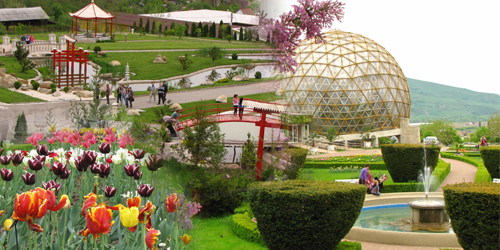
First thing is first, the entry fee: it is 5 RON for adults and 3 RON for students. What is a good added value: it is open on May the 1st, the famous work-day of the country, a day when actually nothing else is open, because nobody is working :). The garden’s main botanical attraction-theme is the abundance of tulips. A quite wide range of tulips decorates all pathways right after the main entrance, blossoming in all colors of the rainbow. It is quite interesting to see the various colors and shapes of these flowers, which have been gathered from all over the world. Although it was a cloudy day, I really had to take it easy with the color intensity while taking photos, they really are that bright…

Of course the same arranged gardens are present also here as in the big one in Cluj: a Roman garden, a Japanese garden and the usual cactus gardens. All pretty nice, though much smaller in size. The green-houses are present also in this botanical garden. These ones seem a bit more creative: they are shaped in spheres and although they do not accommodate such tall palm-trees, they offer a quite big area for an abundance of tropical plants. The botanical garden, however is being extended: a huge area is already arranged with pathways, but yet to be covered with larger plants. The new area is actually bigger than the original site, so it more than doubles the total size of the garden. This can be visited also, but it is mostly the sculptures and the shape of the pathways that can be admired here for the time being…
Botanical Garden Jibou
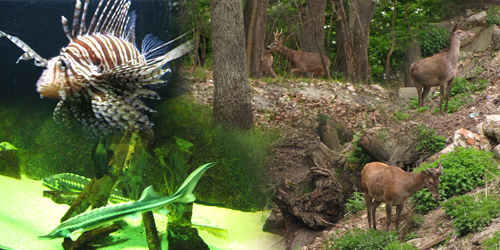
The botanical garden of Jibou holds, however, a huge added bonus, which can drive children crazy: a mini-zoo. This mini-zoo is actually composed of two parts: the aquarium complex and the deer-garden. The aquarium complex is attached to the green-houses and it presents a wide range of fish from the tropical ones to ones living in the Danube-delta. The deer-garden is actually a large fenced area which is populated by a few deer and elk families. Also next to them there is a separate fenced area holding the wild-boar families in the same manner. The animals are easy to spot as they are grazing peacefully within the trees. It is quite a nice experience, so don’t be lazy and do the long walk around them (yes, it is a bit of a long walk for a botanical garden… 😛 ).

It took us quite some time to do the actual visit. I think the whole thing lasted around 3 hours, but I cannot remember exactly… Anyway it was quite a nice surprise for me, because I did not know anything about it, and yet there it was and to say the verdict: it was not that bad 🙂 . I have to admit its flora is much poorer than the one from Cluj, but with all added values, it is a good alternative…

More photos here.

[13]

A Hidden Garden

May 5th, 2011

As I have mentioned in yesterday’s post I am going to describe all three places we have visited last weekend in more detail. The first place we have visited is called The Garden of the Ogres and indeed I think this is the best name one could give for a place such as this one. The Romanian name is a bit odd “Gradina Zmeilor” (a close match would be “Garden of the Dragons”), but someone came up I guess with this more expressive English name, which I like better, so I am going to use that in my descriptions.
Garden of the Ogres
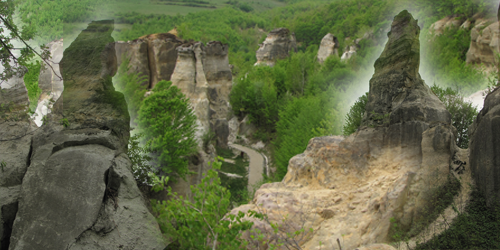
I have already described the details about how we got to the place in yesterday’s post, so I will skip that here. I’ll just start from the parking lot: the parking lot is actually a small fenced area covered with grass where people can leave there cars. There is no entry fee, no parking fee… just grass 🙂 . From then on one can easily spot the trail leading into the garden. This trail does a circle in the garden, so the only dilemma on how to organize the visit is which road to take: clockwise or counterclockwise. I suggest the counterclockwise option, it is more impressive to have an astonishing glimpse of the entire “ogre” group first and then move on to see the details.

The route itself is quite easy, but for the ones having a spirit of adventure it is always easy to spot narrow routes to climb up the cliffs and get ahead of the group who lazily follows the trail leading up to the “grand view-point” from where the entire garden can be seen. The view is indeed rewarding (no matter which route you take). I have never seen rock formations such as this before and they really provided a surprising view to say the least. Yes, this is the grand photo-shoot place: take photos of the entire view, zoom in on things, spot interesting curves… go ahead, have fun, find the perfect composition for your Picasa album ;).

After satisfying the joyful photographer from inside, it is time to move on following the ridge of the cliffs among the woods. There are small “balconys” to satisfy the little photographer from inside, so no worries, the photos will get better and better 🙂 . During this short walk along the ridge there are ample possibilities to watch the formations from every angle and admire their beauty. As one gets along and starts to get to the edge of the garden and realizes that the distance to the bottom of the cliffs is still above 6-7 meters, a little voice starts to get louder and louder in ones head: how am I going to go down from here? 😀

At the very edge of the garden, still on the ridge of the cliffs, the answer to the annoying voice inside will emerge. I can’t say it will be a pleasant answer, but it will be there: a steep descent into the bottom of the cliffs. Luckily there are some improvised railings which help. I am not saying that it is a deadly descent, but don’t go there in high heels, they are just… inadequate 😛 .

Once arrived down to the ground, the route allows the excited visitor to get closer to the formations and take some more photos, now concentrating on details (yes, it’s time for macros too). Among being able to read the actual names of each formation, there is a possibility to try to go trough the tight cracks among them which is kindof cool 🙂 . Also do not miss the cave and the small swampy area below the ridge.

Although the area is somewhat adapted for the occasional excursionist, the place offers some challenges for the more spirited individuals. This makes the place really attractive for a broad range of visitor-types. The arrangements also include things like waste-baskets which allow visitors to keep the place clean without throwing away that annoying chips-bag or juice bottle in the woods (nice touch 😉 ) . It took us around an hour to do the trip in the garden and it was worth every second of it, so I recommend it to anyone who has the chance and time to visit it.

And because there was a little photographer also inside of me, I have also made some photos, which can be seen on my Picasa acount.

[12]